

Sifnos, Greece: the complete island guide
Sifnos is a Cycladic island in Greece, about 14 km long, known above all for its cooking, its pottery and a network of waymarked stone footpaths. Apollonia is the lively hilltop capital, Kamares the ferry port, and the beaches and villages are spread widely enough that a car or scooter transforms the visit.
Sifnos sits in the western Cyclades, roughly halfway between Athens and Santorini but a world away from either in temperament. It is about 14 km long and 7 km wide, home to some 2,600 permanent residents, and it has built a reputation across Greece for three things: exceptional food, a centuries-old pottery tradition, and one of the best waymarked hiking networks in the islands.
What it does not have is an airport, a cruise terminal or a party scene. That absence is the point, and it is why Sifnos attracts people who return year after year rather than ticking it off a list.
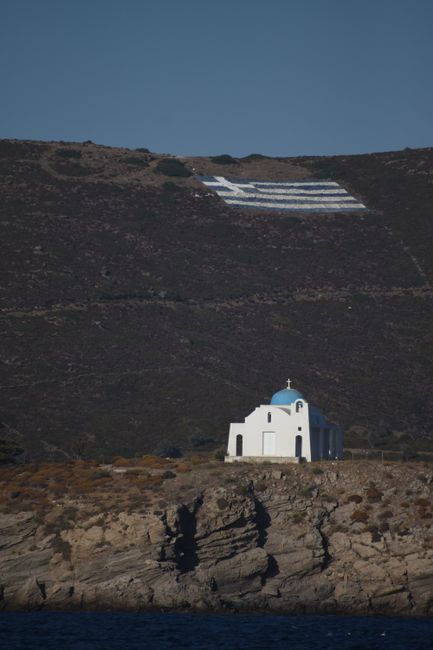
What makes Sifnos different
Greek islands tend to specialise. Mykonos does nightlife, Santorini does the caldera view, Milos does extraordinary geology. Sifnos does food, and it does it seriously.
The island produced Nikolaos Tselementes, whose 1910 cookbook was so influential that his surname became the ordinary Greek word for a recipe book. That lineage still shows: village tavernas here cook with an ambition you would not expect from their size. Look for revithada, chickpeas slow-baked overnight in a ceramic pot, traditionally in the village baker's wood oven on a Saturday night for Sunday lunch, and mastelo, lamb or goat cooked in a clay vessel with dill and wine.
The pottery is not a souvenir industry, it is the reason the ceramic cooking pots exist. Workshops around Kamares, Artemonas and Vathi still throw and fire pieces the way the island has for generations.
The third strand is walking. Sifnos maintains a network of restored stone footpaths, many of them ancient routes between villages and monasteries, properly waymarked and genuinely walkable. Several of the best beaches and chapels are more rewarding reached on foot than by road.
Geography in one minute
The island splits neatly into two zones.
The central ridge holds the linked inland villages: Apollonia, the capital, with Artemonas immediately north, plus Exampela, Katavati, Kato Petali and Ano Petali close enough to walk between. This is where most of the population, the restaurants and the evening life are.
The coast below holds the scattered settlements: Kamares to the west, where the ferries dock; Platys Gialos, Faros and Chrysopigi to the south; Vathi to the southwest; and Cherronisos far to the north. Kastro, the medieval capital, clings to a cliff on the east coast.
Nothing is more than about 25 minutes from Apollonia by road, but the roads are narrow and winding, so map distance is a poor guide to travel time.
How many days do you need?
Three days covers the essentials: the inland villages, Kastro, and two or three beaches.
Five to seven days is the sweet spot. Enough to reach the north coast, walk a couple of the footpaths, eat properly, and have a slow day.
Ten days or more and you stop being a visitor. Plenty of people do exactly this and consider a fortnight the minimum.
When to go
| Period | What to expect |
|---|---|
| April to mid-May | Green, wildflowers, cool sea, many places still closed |
| Mid-May to June | Warm, quiet, everything open, excellent value |
| July to August | Hot, busy, full ferries, the meltemi wind, book far ahead |
| September | The connoisseur's month: warm sea, thinning crowds, calm |
| October | Beautiful and quiet, businesses begin closing mid-month |
| November to March | Genuinely quiet, limited ferries, a different island |
If you have a free choice, September is the best month on Sifnos. The sea is at its warmest after a summer of heating, the August crowds have gone, and the light is remarkable.
The villages
Apollonia is the capital and the centre of gravity, built along a ridge with a pedestrianised lane of restaurants, bars and shops that stays busy late in summer.
Artemonas, fifteen minutes' walk north, is the elegant one: neoclassical mansions, wide flagstoned lanes, superb patisseries and a much quieter evening.
Kastro is the extraordinary one. The medieval capital, a fortified village wrapped around a clifftop headland with Venetian coats of arms above the doorways and the Aegean on three sides. Go for sunset, stay after the day visitors leave.
Kamares is the port, and a proper resort in its own right with a long sandy beach.
Faros, Platys Gialos and Vathi are the coastal settlements, each built around its own beach.
The beaches
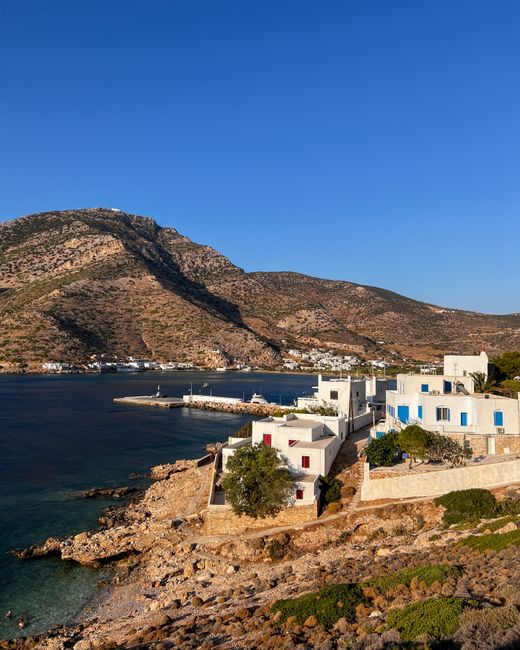
Sifnos beaches are sandy, mostly south facing and mostly small. Platys Gialos is the longest and best equipped. Vathi is a sheltered horseshoe bay with unusually calm water. Kamares has shallow water ideal for children. Chrysopigi offers swimming from rocks beneath the island's most photographed monastery, with the sandy Apokofto next door. Faros has three small coves within a few minutes of each other. Further out, Cherronisos in the far north and Fykiada and Vroulidia reward the effort of reaching them.
Full detail, including access roads and parking, is in the beaches guide.
Getting there
There is no airport. You fly to Athens, transfer to Piraeus port, and take a ferry to Kamares, roughly 2.5 to 3 hours by high-speed catamaran or about 5 hours on a conventional ferry. See how to get to Sifnos and the ferries guide.
Getting around, and why it matters
This is the practical heart of a Sifnos trip. The island is small, but the good things are spread around the coast and the bus network, while real, is infrequent, fills up in August and dictates your schedule.
The distances are short: Apollonia to Platys Gialos is about 20 minutes, to Kastro about 10, to Vathi about 20, to Cherronisos about 35. With your own wheels you can swim at two beaches and still be back for dinner in Apollonia. Without them, that is a day of waiting at bus stops.
A car suits families, anyone with luggage, and travel in windy weather. A scooter suits solo travellers and couples doing short hops in settled conditions. Roads are sealed and well maintained but narrow and winding, with few barriers, so drive slowly and give way uphill where the road pinches.
Where Artemis fits
We have rented cars, scooters and motorcycles on Sifnos from the same Apollonia office since 1988, as a family business. Free delivery to Kamares port, the heliport, Apollonia, Artemonas and Kastro, with Vathi, Platys Gialos, Faros, Chrysopigi and Cherronisos available on request.
No prepayment and no card details to reserve. Third-party insurance, maintenance, helmets and local help are already included in the daily rate. Tell us your ferry arrival time and the car will be waiting at the port.
See the fleet and rates · Reserve dates · Beaches guide · Where to stay